
 Sep 15, 2025
 Syllabus
How to Cover the RBI Grade A Syllabus with Daily Planning
Preparing for the RBI Grade A exam can feel overwhelming, especially when there is no official RBI Grade A syllabus. With a dream to join the Central Bank of India, you can expect that, similar to the RBI Grade B exam, many aspirants will work hard to crack this exam.
But how can you beat the high competition?
Well, one of the best ways to prepare for the RBI Grade A 2025 exam is through daily planning.
In this article, we’ll guide you on how to cover the RBI Grade A syllabus with daily planning.
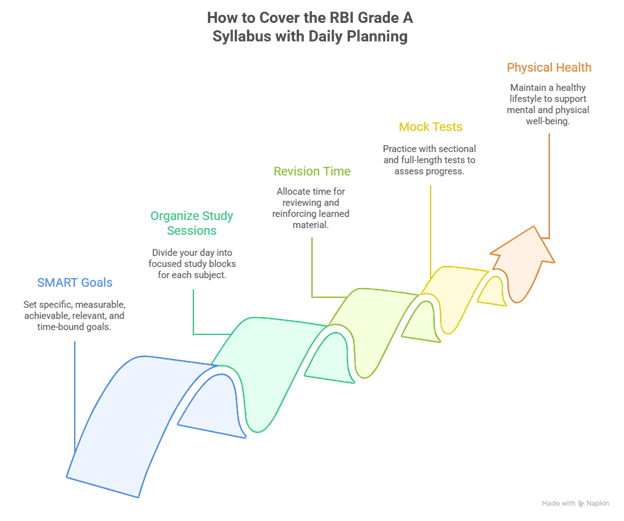
Step 1: Follow SMART Goals Strategy
SMART goals mean:
- Specific
- Measurable
- Achievable
- Relevant
- Time-bound
Here are some examples that you can take an idea from:
- Goal of Week 1: Cover special reasoning topics:
- Blood Relations
- Puzzles
- Seating Arrangement
- Coding-Decoding
- Goal of Week 2: Cover specific Quant topics:
- Simplification
- Approximation
- Profit & Loss
Step 2: Organize Your Day Into Multiple Study Sessions
Treat each day as a separate entity and divide it into separate study blocks. Below, I have provided an example that’ll help you plan your day:
|
Session |
Duration |
Remarks |
|
Morning |
2 hrs |
Focus on Quantitative Aptitude. Spend an hour on foundational topics like Time and Work, and another hour on Profit and Loss. |
|
Afternoon |
2 hrs |
Dedicate this time to the English Language. Practice Reading Comprehension for 45 minutes and focus on Error Spotting for the remaining 15 minutes. |
|
Evening |
2 hrs |
Study General Awareness. Spend 2 hours on current affairs and the other on banking awareness. |
Step 3: Don’t Neglect the Revision Time
Revision is a critical part of your RBI Grade A preparation. It helps you retain what you have studied. Without revision, you won’t be able to recall information correctly, and you’ll suffer in the exam when pressure is already high.
Here is how you should revise:
- Spend at least 30 minutes each day to revise your previously covered topics.
- Set aside 1-2 hours weekly to go over all the topics you've covered.
- You can save time by creating short notes for revision.
Step 4: Practice Sectional and Full-Length Mock Tests
After completing each topic, you should practice questions from that particular topic. After completing at least 40 percent of the entire syllabus, you should start practicing mock tests.
Here is how you can use mock tests effectively:
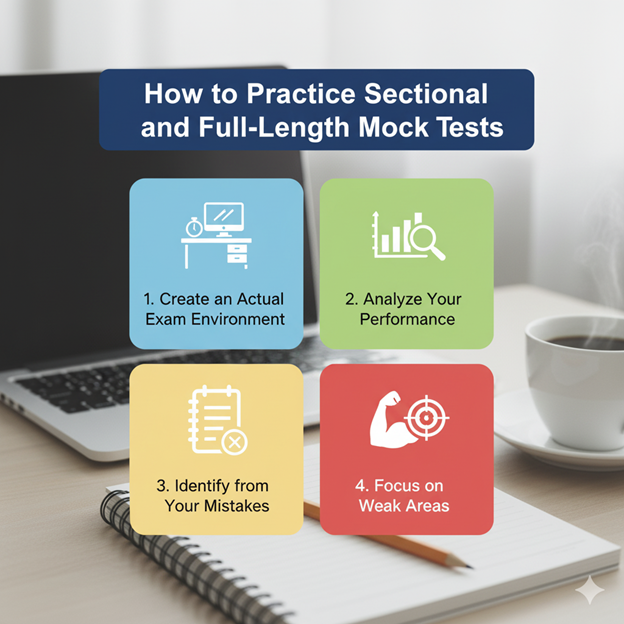
Create an Actual Exam Environment
- When you take a full-length mock test, make sure it’s a time-bound test.
- This mimics the pressure and conditions of the real exam, so you get used to managing your time.
Analyze Your Performance
Attempting mock tests alone is not enough to improve your performance. You need to carefully analyse how you performed in each mock test.
- Review the questions you answered incorrectly
- Check the questions you were unable to answer
- Note the questions that took more time to solve
Identify from Your Mistakes
The most important step is to learn from your mistakes. Hence, you should write down the reason for each mistake to see patterns in your mistakes. For example:
- Misread the question/ number
- Forgot the formula
- Didn't know the rule of any particular topic
After a week or two, go back and try to solve the same questions you got wrong. If you get them right, you've successfully learned from your mistake. If not, it's a signal to spend more time on that topic.
Focus on Weak Areas
After identifying your weak areas, here is how you can improve them:
- Revisit the basic concepts of each weak topic.
- Seek help from a mentor to get a clearer understanding.
- Practice a variety of questions on those particular topics.
- Make a short note of your weak areas.
- Note down their key formulas and shortcuts/tricks to solve questions.
Now, after doing this, you need to go back to the mock tests and try solving those questions again to check whether you still need to invest more time in those topics.
Step 5: Take Care of Your Physical Health
Many students only focus on their mental health and keep on reading, but they often neglect their physical health. Let me tell you clearly, to crack the RBI Grade A exam, you need to be both physically and mentally fit.
You can follow these tips to stay fit:
- Exercise for at least 20-30 minutes daily.
- Avoid fast food and focus on a healthy diet.
- Make sure you get 7-8 hours of sleep each night.
- Drink plenty of water throughout the day to stay hydrated.
- Take frequent small breaks to avoid burnout.
- Try deep breathing to stay calm and focused.
- Reduce your screen time for leisure.
Conclusion
A daily study plan is crucial for your success. By following the steps mentioned in this article, you can cover the entire RBI Grade A syllabus efficiently.
The secret to success is consistency. Stick to your routine, and you'll be well on your way to achieving your goal.