 Mar 18, 2026
 News
News
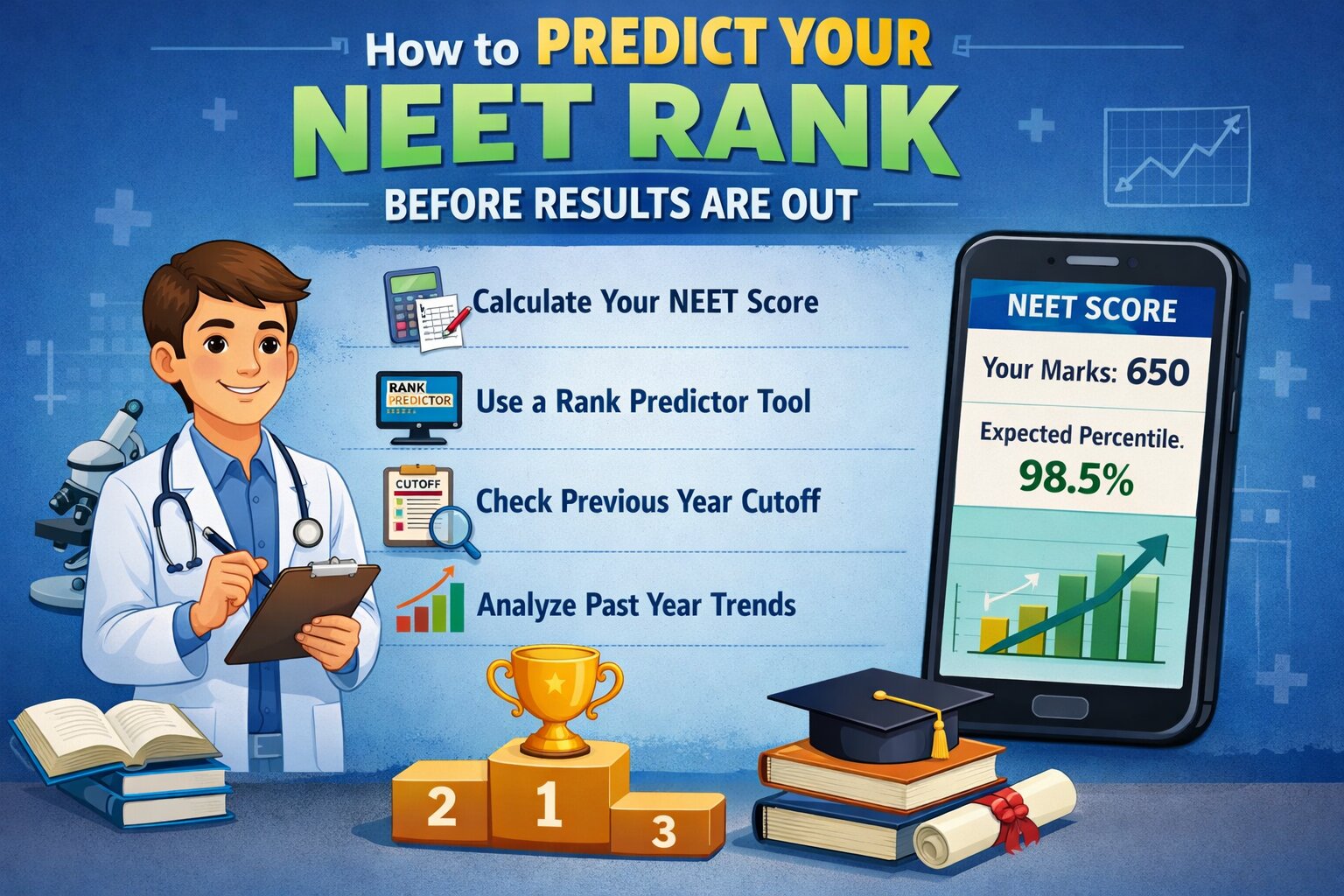
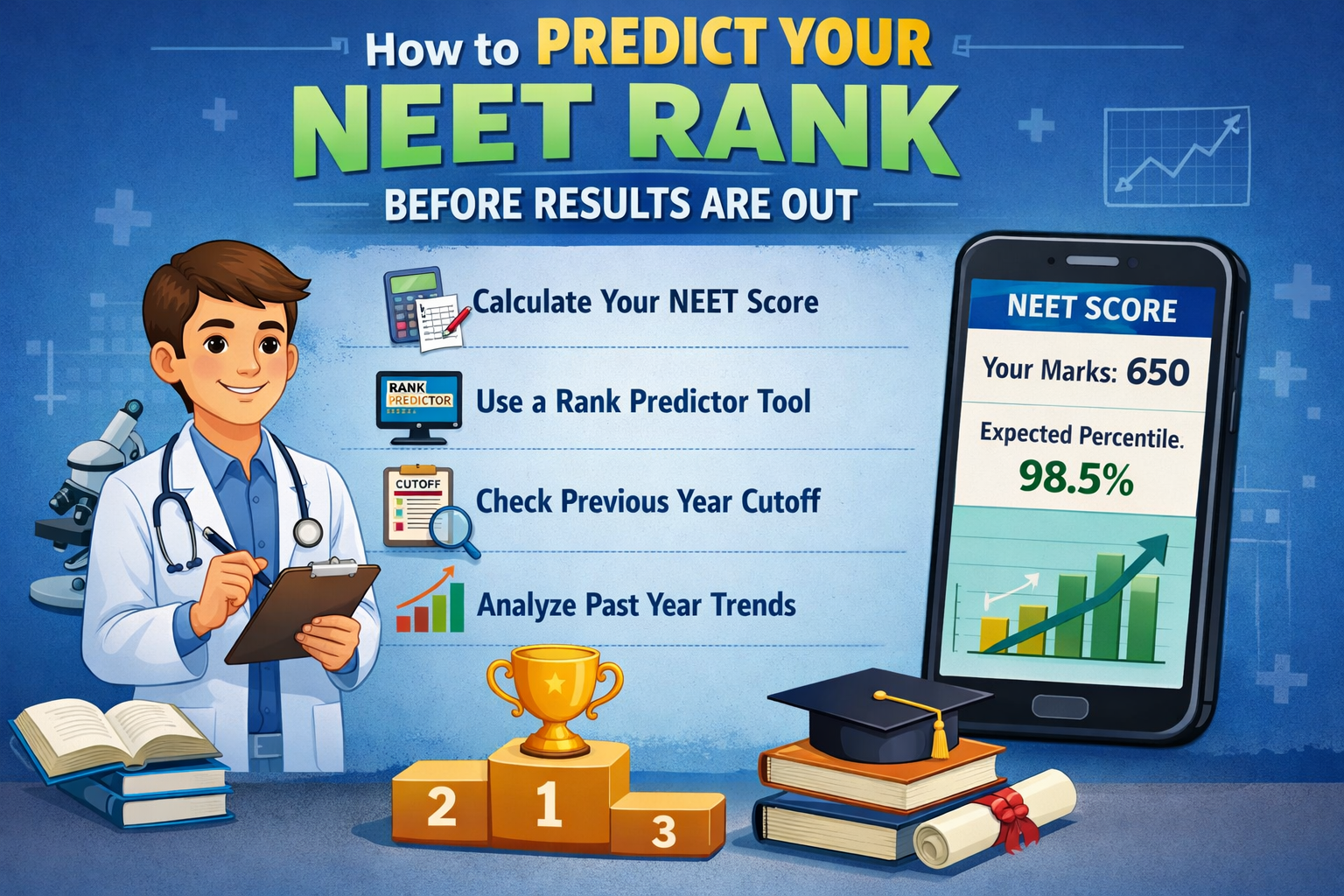
How to Predict Your NEET Rank Before Results Are Out
Every year, millions of students appear for NEET and spend the days after the exam in anxious uncertainty. The results take weeks to arrive, but your score — and a rough idea of your rank — doesn't have to wait that long.
If you've appeared for NEET and want to know where you stand before the official results are declared, here's exactly how you can predict your rank.
Why Predicting Your NEET Rank Matters
Knowing your approximate rank early gives you a significant advantage. You can:
- Start researching which colleges fall within your rank range
- Understand whether state quota or All India Quota works better for you
- Decide early if you want to consider AYUSH courses or plan a drop year
- Avoid last-minute panic during counselling
Waiting passively for results means you lose weeks of preparation time that could be spent planning your next move.
Step 1: Calculate Your NEET Score First
Before predicting your rank, you need your estimated score. As soon as NEET concludes, the National Testing Agency (NTA) releases the official answer key — usually within a week.
Use the official marking scheme:
- +4 for every correct answer
- -1 for every incorrect answer
- 0 for unattempted questions
Tally your score across Physics, Chemistry, and Biology carefully. This raw score is your starting point.
Step 2: Understand How NEET Rank is Determined
NEET rank is not just about your total score. When two or more students score the same marks, NTA uses a tie-breaking criteria in this order:
- Higher marks in Biology
- Higher marks in Chemistry
- Higher marks in Physics
- Fewer incorrect answers overall
- Older candidate gets preference
This means your subject-wise performance matters, not just your total. A student scoring 600 with stronger Biology will rank higher than another student with 600 but weaker Biology marks.
Step 3: Use a NEET Rank Predictor Tool
Once you have your estimated score, the fastest way to get your predicted rank is to use an online rank predictor. Platforms like JEE Predictor have built dedicated predictors for both engineering and medical entrance exams. You can use their NEET rank predictor to get an accurate rank estimate within seconds, based on your score, category, and real-time data from other students who appeared in the same exam.
A good NEET rank predictor will ask for:
- Your estimated score
- Your category (General, OBC, SC, ST, EWS)
- Sometimes, your state of domicile
Within seconds, you get a predicted rank range that reflects where you're likely to stand among all NEET candidates nationally.
Step 4: Map Your Predicted Rank to Colleges
Once you have your predicted rank, you can cross-reference it with previous years' opening and closing ranks for medical colleges across India. Here's a rough idea of what ranks typically get:
Predicted Rank | What You Can Expect Under 1,000 | Top government medical colleges — AIIMS, JIPMER, Maulana Azad 1,000 – 10,000 | Strong government colleges in most states 10,000 – 50,000 | Government colleges in some states, good private colleges 50,000 – 1,00,000 | State quota seats, mid-tier private colleges Above 1,00,000 | Private colleges, deemed universities, AYUSH consideration
These are approximate ranges and vary significantly by category and state. Always verify with the official MCC and state counselling data.
Step 5: Think About Quota — AIQ vs State Quota
Many students overlook this. 15% of government medical college seats fall under the All India Quota (AIQ), where you compete with students from across the country. The remaining 85% are state quota seats, where you only compete with students from your home state.
If your state has fewer NEET aspirants or lower competition, your state quota rank can be significantly more favourable than your all-India rank. Factor this in when assessing your college options.
Don't Wait for Results to Start Planning
The students who make the best counselling decisions are usually those who started planning early. Use the time between your exam and results to:
- Shortlist 10–15 colleges across AIQ and state quota
- Understand fee structures and bond conditions for private colleges
- Research cutoffs from the past 3 years for your target colleges
- Talk to seniors already enrolled in colleges you're considering
Your predicted rank gives you the starting point. The rest is planning.
Final Word
Uncertainty after a high-stakes exam is natural, but it doesn't have to be paralyzing. With your estimated score and the right tools, you can get a clear, data-backed picture of your rank and start making informed decisions weeks before official results arrive.
The earlier you know where you stand, the better prepared you'll be for counselling — and for whatever comes next